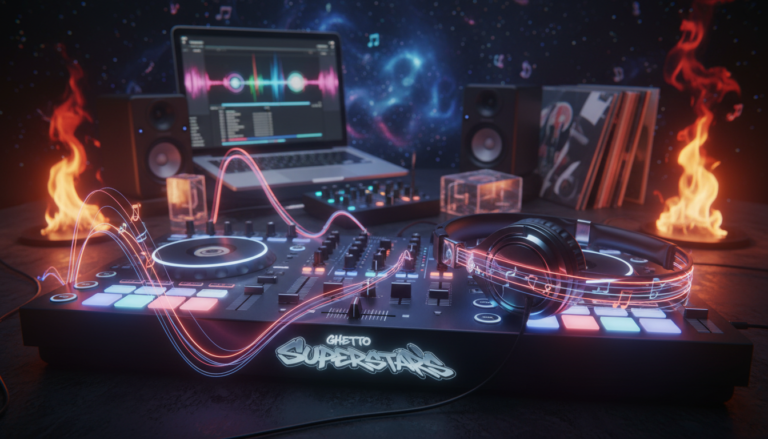

Can a single playlist lift a room and make strangers become a community?
That is the challenge. A true party DJ craft is about reading the room and reacting fast. House gatherings move quick. Speakers are small. Neighbors notice bass. You play to the moment, not chase a festival show.
We open with what PARTY DJing really means: making real people feel something in real time. You’ll get a simple roadmap of what to practice first, what to prep, and how to stay calm when the room shifts.
Ghetto Superstars is more than djs and event services — we’re a creative hub. We share Free AI Music Tools, mixes, and a Uganda services ecosystem teaser to inspire your sets. Reach out to learn, swap mixes, or book guidance. The focus here is learning and community.
Key Takeaways
- Play the room. Energy changes fast.
- Start with gear basics and a tight music library.
- Plan mini sets and cue points, not long playlists.
- Keep neighbors and time in mind.
- Lean on community resources like Ghetto Superstars.
What Makes Party DJing Different From Club DJing
House sets live in small moments; the best ones change course when the room shifts. In a house you’re close to the people. That proximity lets us pivot genres, tempos, and moods faster than in a club.
Play to the moment. Focus on track selection more than flawless blends. Most guests won’t grade your technique. They feel energy and drop away when the music gets flat.
Embrace the intimate setting and play to the moment
We read the room and react. A friend arrives. The snack table empties. Energy rises or dips. Ten minutes can alter the whole atmosphere.
Prioritize track selection over flawless mixing
The right track at the right time beats a perfect transition at the wrong time. On small systems, vocal hooks and clear beats land better than heavy low-end textures.
Think in “mini sets” as the room’s energy shifts fast
Plan 10–20 minute lanes. Drop a vibe, watch the crowd, then pivot. Move from downtempo to hip-hop to pop when it fits the night, not the genre map.
“We play to connect. One smart track can flip a room faster than two perfect phrases.”
- Intimacy: quicker pivots than a club.
- Sound: club low-end vs house system limits change song choice.
- Sequencing: mix textures and vocals to avoid monotony.
| Aspect | House | Club |
|---|---|---|
| Audience Proximity | Close — direct feedback | Distant — broad reads |
| Set Length | Mini sets (10–20 min) | Long arcs (30+ min) |
| Sound Expectation | Limited bass; clear mids | Powerful low-end |
| Music Strategy | Track-led, flexible | Mix-led, thematic |
Set Your Goal: The Vibe, the Audience, and the Room
Start by naming the feeling you want the room to carry in the first half hour. A single sentence keeps the plan tight. It guides choices when the night moves fast.
Reading the atmosphere: friends, strangers, mixed crowds
Define one-line goals: first 30 minutes, peak, wind-down. That gives us a simple map to follow.
Friends tolerate weird tracks and deep cuts. Strangers need familiar hooks. Mixed crowds ask for safe, rhythmic picks.
Helping people leave the kitchen and hit the dance floor
Make the main space feel like the place to be. Start warm. Add clear, familiar grooves. Then nudge energy up without overshooting into aggressive club music.
- Watch body language: head nods, foot taps, phone-in-hand.
- Set micro-goals: get five people moving, then ten, then the whole floor singing.
- Hospitality with BPM: comfort first, momentum second.
“We aim to create connection: steady trust beats sudden shock every time.”
| Goal Phase | Action | Why it works |
|---|---|---|
| First 30 minutes | Play warm, familiar music | Build trust and pull people out of the kitchen |
| Peak | Raise rhythmic energy; call-and-response hooks | Maximize movement and singalongs |
| Wind-down | Smooth, lower-tempo tracks | Keep comfort and avoid sudden exits |
Gear and Setup Basics for a Smooth Party (Even on a Budget)
A solid setup keeps the music flowing and the room happy. We keep gear simple and reliable so you can focus on the vibe. Small systems need clear mids and tight playlists that survive a volume cut.
Controller or decks, headphones, and a reliable source
Non-negotiables: a controller or decks, sturdy headphones, and a dependable music device. Offline playback wins when Wi‑Fi fails.
Bring a backup phone or USB. A quick swap keeps the mix alive with zero panic.
Sound reality: bass limits, neighbors, and noise complaints
Most house setups lack heavy bass. Expect a mid-volume night and plan a low-bass playlist. If someone asks you to lower it, drop the sub and keep the groove.
Quiet hours matter. Watch walls, check windows, and adjust before a complaint ends the night.
Lighting and staging that make your booth a place
Small touches lift the room: LED strips, a warm lamp, or a compact light bar. Clean table. Cables tucked away. Drinks far from gear.
- Pre-party soundcheck: walk the room, check vocal clarity, tame harsh highs.
- Contingency checklist: spare cables, power strip, phone charger, backup playback.
- Professional habits: label sources, set volume caps, and make sure your workspace is steady.
“Preparation keeps the night moving; small fixes save big moments.”
These simple ways keep the party steady from start to end. We set the stage, you carry the energy.
Music Selection and Library Building That Actually Works at Parties
Good music selection is less ego, more empathy: play what pulls people together. We build a lean library that moves a room, not a resume.
Choose genres for the crowd, not just your personal taste. Start with pop and hip-hop when the system is small. Those songs have clear hooks and cut through limited bass.
Use vocal hooks and familiar songs
Vocals land. Hooks make people sing along. On a low-volume system, a strong chorus does more than a heavy sub-bass.
Build a dependable offline library
Own your files. Rely on MP3s or purchased tracks so the party never stalls when streaming drops. Test new downloads in your software before the night starts.
Organize crates by energy, time, and style
- Warm-Up
- Kitchen Grooves
- Hands-Up Singalongs
- Peak
- Afterhours/Chill
“A clean playlist system lets us pivot fast and keep the room together.”

| Crate | Primary Genre | Energy |
|---|---|---|
| Warm-Up | Pop / R&B | Low–Medium |
| Kitchen Grooves | Soul / House | Medium |
| Hands-Up | Hip-Hop / Pop | High |
| Afterhours | Chill / Downtempo | Low |
Core DJ Skills Beginners Need Before the First Party Set
Before you touch a playlist, learn the craft that keeps a set steady: phrasing, beatmatch, and tempo control.
Song structure and phrasing. Most modern songs use 8-bar phrases. Start transitions only at phrase boundaries. That makes a blend feel natural and helps vocals land cleanly.
Song structure and phrasing: mixing in 8-bar patterns
Count bars. Mark intros, hooks, and outros. Begin mixes on a phrase change so listeners don’t feel the edit.
Beatmatching fundamentals (and why you shouldn’t rely on sync)
Beatmatching by ear aligns BPM and phrasing. Screens lie. Grids drift. Older gear has no sync. Train your ears to nudge jog wheels until the tracks lock.
BPM strategy: start with tracks close in tempo to keep it clean
Use similar BPMs early. Narrow jumps keep energy smooth. Widen tempo only when you can control the shift and read the room.
- Practice drill: loop intros/outros, cover the screen, fix drift with jogs.
- Record short practice mixes to hear issues you miss live.
- CONFIDENCE KIT: phrasing + beatmatching + tempo management = less panic, more presence.
Ghetto Superstars services can help with hands-on lessons and gear prep if you want a guided course.
DJing tips for parties: Build a Party-Proof Playlist and Setlist Plan
Craft a setlist that lets you pivot without panic when the night flips. We make plans that bend, not break. A clear structure gives you options, not rules.
Start with a tight practice playlist — about 20–40 tracks. Learn how songs flow into one another. Practice the order until transitions feel natural.
Prep cue points for faster choices
Mark clean intros and clean outros. Cue points cut the “what now?” moments when the crowd watches you. They speed decisions and keep mixes tidy.
Map three lanes—ROWDY, PEAK, CHILL
Label crates by energy. ROWDY is reckless favorites. PEAK holds singalongs and big hooks. CHILL brings a gentle wind-down.
Make a low-bass backup playlist to handle neighbor pressure. Same vibe. Less sub. You keep the energy without risking complaints.
- Plan moment tracks: throwbacks, singalongs, and birthday anthems to reset the room.
- Think mini sets: 10–20 minute lanes that let you test energy quickly.
- Setlist philosophy: plan options, not prisons — let the party decide the lane.
“Preparation gives you freedom to react. A practiced playlist is a party’s secret weapon.”
Pre-party checklist: analyze tracks, test cue points, export playlists, and bring backups. Make sure your set survives noise limits and bad Wi‑Fi.
Mixing and Transition Techniques That Keep the Dance Floor Moving
A smart switch can lift the room without a single effect. We favor choices that keep people dancing, not technical perfection. In a house setting, the right track at the right moment matters more than a flawless studio blend.
Simple swaps that work in real rooms
Use intro-to-outro swaps, bass swaps, and quick cuts on the one. These moves land on small systems. They keep energy and avoid over-processing. Short and decisive.
When a clean drop beats a long blend
If the crowd needs a reset, drop the hook. A clean drop refocuses attention fast. We pick songs that pull people back to the floor and end doubts before they start.
Break monotony: change texture and groove on purpose
Flip from instrumentals to vocal records, then back. Manage clashing vocals with short mix points, echo-outs, and phrased drops. Keep the groove steady even when style changes.
- Use effects sparingly — punctuation, not cover.
- Energy continuity: match rhythm so dancers keep their pocket.
- The goal: a moving floor and a connected room.
We play to unite people — one good switch can make the whole night.
| Technique | Best Use | Result |
|---|---|---|
| Intro-to-Outro Swap | Smooth tempo shifts | Seamless energy carry |
| Bass Swap | Neighbor request or low systems | Maintains groove without heavy low end |
| Quick Cut / Drop | Crowd reset | Immediate focus on hook |
Want a deeper read on crowd connection and set craft? See our recommended resource harmonizing with the crowd.
How to Read the Crowd and Control Energy All Night
Spot the guest who can’t help but dance and make them your compass. One mover becomes the spark. Feed them a few trusted tracks and watch the ripple.
Musical shoutouts are small, intentional plays that make people feel seen. Use songs tied to shared memories, friend favorites, or a hook everyone knows. This changes the room’s atmosphere fast.
Spot the party-starter and use “musical shoutouts”
Find that spark early. Play into their energy and let the rest of the crowd follow. A single familiar chorus can lift the whole party.
Fix energy dips without panicking
Don’t speed up on instinct. First, change the song’s emotional color—switch vocals, era, or groove. Then rebuild intensity in a short mini set. Calm moves beat desperate ones.
Handle sudden arrivals, exits, and late-night fatigue
When new people arrive, welcome them with high-recognition tracks. If the peak empties, tighten the vibe and go intimate. Late-night fatigue? Lower intensity, keep the warmth, and save one lift track if the night asks.
“Crowd reading is a skill you earn by listening, not forcing your plan.”
Want a deeper method to control a room? Check our practical guide on crowd reading and control.
Level Up Faster by DJing More: Host Your Own Party or Pop-Up
Throw your own night and you speed up the learning curve faster than any practice session. Hosting gives reps, honest feedback, and real pressure—all low-cost. This is the best way to build stage confidence and bookings.
Start small. Pick a tiny venue or a living-room setup. Aim to halve your “success number.” A packed small room feels electric. An empty big place does not.
- Cost control: negotiate zero or low venue fees, borrow gear, and keep spends tight until the concept proves itself.
- Promotion reality: early crowds come from close friends, family, classmates, and coworkers. Repeat the invite—people need to see it several times.
Promotion cadence: DM, text, post, and ask in person. Repetition drives attendance.
Capture momentum. Collect emails, shoot short videos, and take photos. Use that content to fuel the next event and grow your potential as a local brand.
Small, regular nights become a trusted course to bigger bookings and creative freedom.
Tools, Mixes, and Pro Support From Ghetto Superstars
Let technology and community widen what your set can do. We are a creative hub where djs, artists, event planners, and music lovers build culture together. Use our resources to unlock more potential with less guesswork.
Free AI Music Tools speed the parts that stall beginners—DJ name ideas, event concepts, and setlist frameworks. Try them here: https://ghettosuperstars.co/free-ai-music-tools/.
Stream and download mixes and video mixtapes to study transitions, pacing, and energy control. Use recorded sets as practice templates: https://ghettosuperstars.co/download-mixes/.
Pro support in Uganda: book DJ services, sound & PA, lighting, and hosting for any event. We help with production and onsite coordination so your party runs smooth: https://ghettosuperstars.co/services/.
We’re more than bookings. Browse our shop, back the Ghetto Foundation, or hire help. These are real ways to scale your events and grow your music career.
“Better planning leads to better practice, and better parties follow.”
For fast coordination call +256 741 669 338 or email services@ghettosuperstars.co. We guide you step-by-step so every event becomes a stage to show your world-class potential.
Conclusion
End strong by treating the set like a conversation, not a performance.
We summarize the beginner path: set a clear goal, prep your library, plan energy lanes, keep transitions simple, and read the room like an instrument. These steps help one person turn a room into a moving community at one small party or many.
Party-proof checklist: bring backups, respect volume limits, and make sure playlists are organized for fast pivots. The best way to improve is to host small hangs, pop-ups, and community nights—do it often.
Music connects us — and everything you need starts here. Use our Free AI Music Tools and mixes: https://ghettosuperstars.co/free-ai-music-tools/ and https://ghettosuperstars.co/download-mixes/. For events in Uganda book services, sound & PA, lighting and hosting: https://ghettosuperstars.co/services/.
Shop gear, support the Ghetto Foundation, or reach us at +256 741 669 338 or services@ghettosuperstars.co. We show up with resources and heart so you can play music and style music with purpose.